

This piece is grounded in packaging semiotics research that Leapfrog has conducted across spirits (whisky, single malt, scotch, vodka/gin), OTC health (digestive health, vitamins, wellness), beauty (moisturizers, derma care, body care, makeup), and petfood. The thinking below reflects the recurring patterns we’ve seen emerge across this work.
Entering a new category is one of the harder design briefs a brand can face. The incumbents have history — they have already shaped the consumer’s expectations of what the category looks and feels like. A new entrant has to work against that familiarity while also earning a place within it, which means differentiation alone isn’t enough. The differentiation has to be relevant: legible to the consumer, meaningful within the category’s existing logic, and distinctive enough to make a case for itself against players who got there first.
This is where many new entrant pack designs fall short. Visual ambition is rarely the problem, it is usually a lack of structured understanding of how the category produces meaning. Semiotics provides that structure. It gives brand teams a way to read the category’s visual and cultural logic, identify where the real opportunities for differentiation lie, and design with enough precision to compete. The four principles outlined here are the basis of that work.
Principle 1: Belonging x Difference
Most new entrant briefs lead with the same instruction: we want to stand out. It’s a reasonable instinct — the category is crowded, the consumer is time-poor, and if your pack doesn’t catch the eye, nothing else matters. The problem is that this instinct, reasonable as it is, tends to arrive too early.
Standing out is a relational act. It requires being understood as a player in the space before it can register as a preference. A pack that shares no visual or semantic grammar with the category it’s entering doesn’t read as distinctive. It reads as unplaceable. The consumer has no frame within which to make sense of it, and without that frame, the pack cannot compete.
This is why the semiotic work for a new entrant is a sequencing problem before it is a design problem. Every category runs on a set of codes — visual, semantic, cultural — and any new entrant has to carry enough of them to be readable as part of the space. Within that framework, the question of how much to differ becomes both meaningful and answerable.
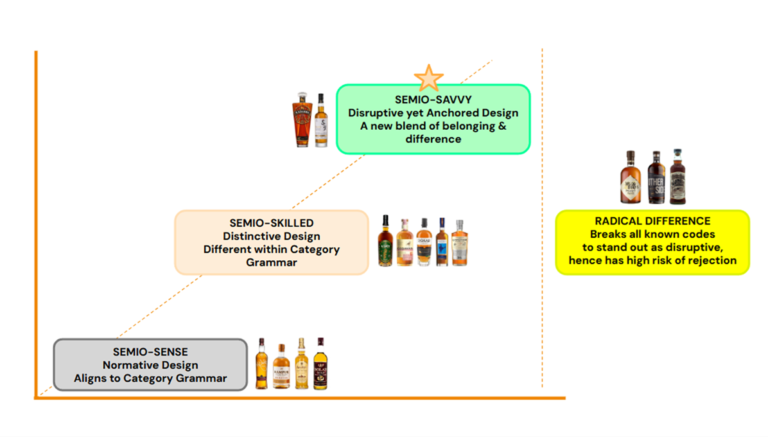
Brands can choose from an upward ladder of semiotic ambition.
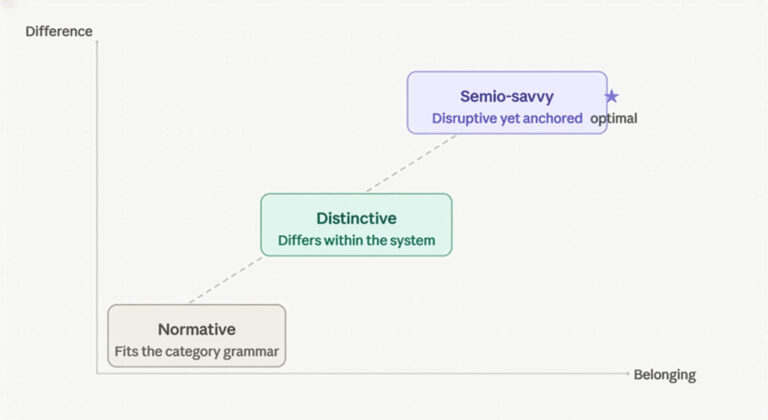
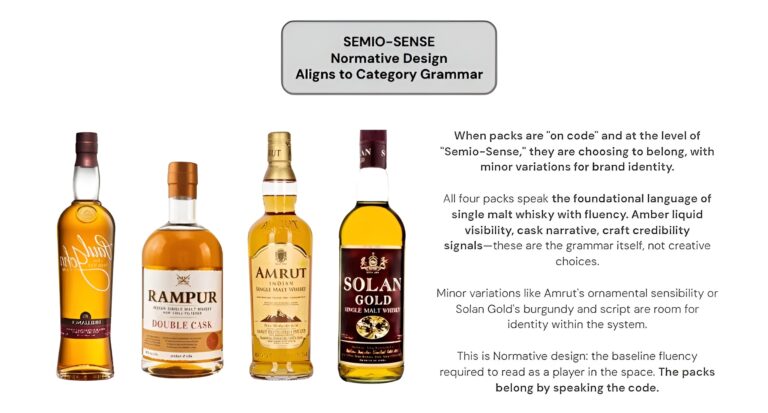
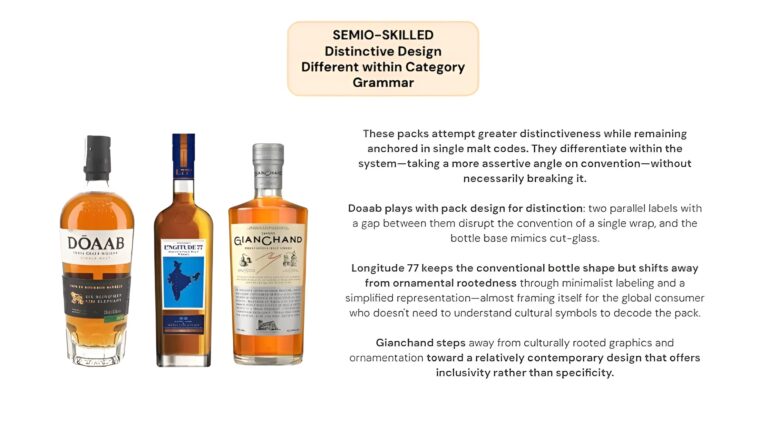
At the base, packs fit squarely within the category’s established grammar, speaking its normative design language reliably and legibly. A rung above, they take a more distinctive angle on convention — differentiating within the system without breaking it, though without necessarily leaving a strong impression either.
At the top sits the semio-savvy pack — what we call the most strategically sophisticated position: disruptive and differentiated, yet anchored in the foundational codes that give the category its boundaries. A semio-savvy pack knows the rules well enough to break them meaningfully, which is what makes it the only position on the ladder that achieves both recognition and recall.
This ladder becomes a practical tool when applied to real category spaces. Here’s how it works in practice.
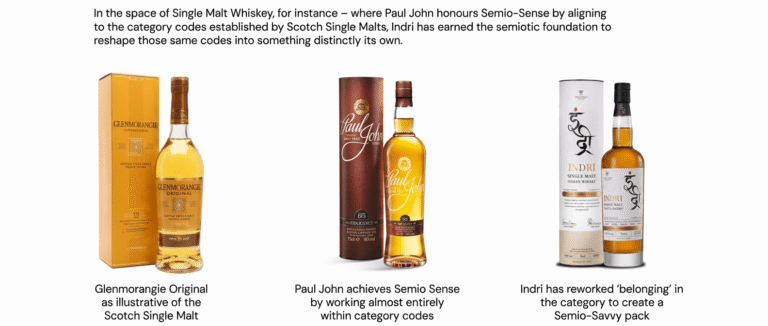
Each of these positions rests on a distinct semiotic strategy. Let’s break down how each brand encodes belonging and difference.
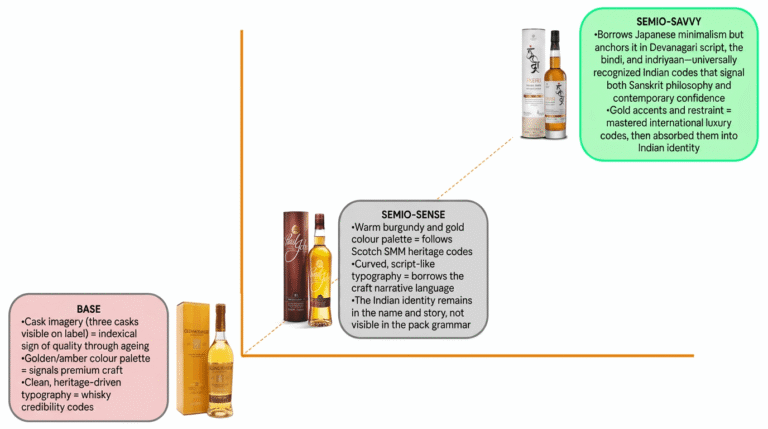
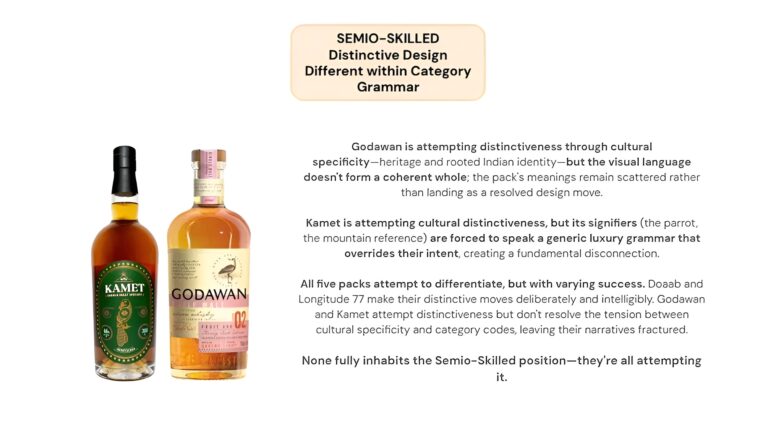
For a more indepth understanding of how packs come to sit on this ladder, see the visual case study at the end of this piece, which maps the major players in Indian Single Malt Whiskey across the ladder, with explanations for each.
Principle 2: The Hidden Structures That Generate Resonance
What makes a pack resonate with a consumer is rarely what a brand team can immediately name. Beneath every design decision lies a set of psychological and cultural structures that do the actual work — and because consumers feel their effect without articulating them, they tend to remain invisible to the people making design choices too.
A semiotic decode surfaces these structures across two linked layers. The first is the layer of psychological drivers — the internal motivations that a pack must speak to in order to feel credible and resonant. These include the consumer’s need to believe in a product’s efficacy, their desire for aesthetic pleasure, their sense of cultural belonging, their aspiration toward status, and their investment in personal identity.
The second layer is where those drivers get translated into visible form: the culturally codified design conventions — colour, typography, shape, material, information architecture — through which resonance is styled and made legible.
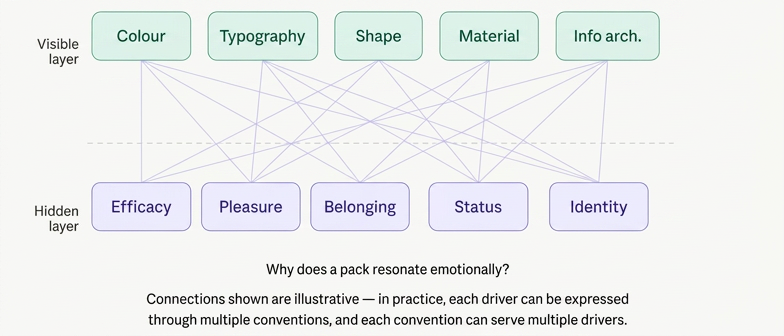
The reason both layers matter is that they answer different questions. The first tells you why a pack works emotionally. The second tells you how that emotional logic is expressed. A brand that only reads the second layer knows what the category looks like, but remains in the dark about why it resonates. That gap is where design decisions that look right but feel wrong tend to originate.
This is also where the semio-savvy pack earns its position. Operating at the top of the semiotic ladder requires more than fluency in the visible codes of a category — it requires an understanding of the psychological layer beneath them. A pack that disrupts the category’s design conventions while remaining resonant does so because its makers understood what those conventions were doing at the level of motivation, not just appearance. Semiotics makes that understanding available as a deliberate strategic input, rather than leaving it to intuition or luck.
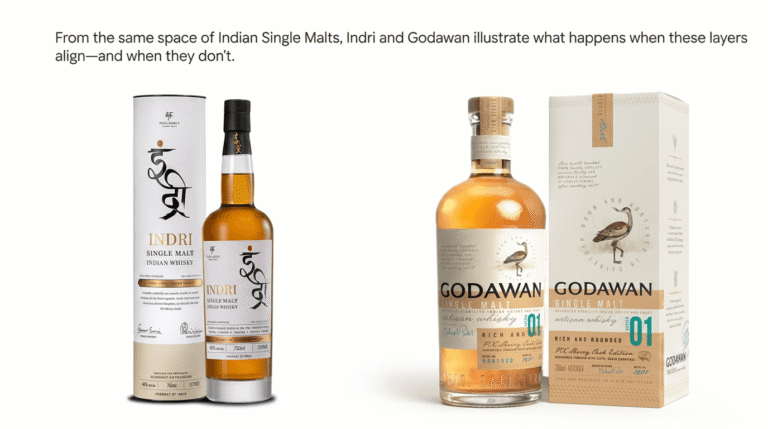
Indri: Recognition Works
The WHY (hidden structure): A contemporary, self-assured India that doesn’t need ancient heritage or royal tradition to feel legitimate.
The HOW (visible signs that activate it): The name itself is Sanskrit for the five senses—what other whisky brands communicate as tasting notes, Indri has absorbed into its identity. Devanagari script dominates the bottle with English subordinate to it—a reversal of hierarchy that signals Indian confidence. A single red dot—placed with the precision of a bindi—reinforces cultural identity without performance.
What happens: The hidden structure activates without explanation. Resonance is immediate.
Godawan: Recognition Fails
The WHY (hidden structure): Globalised Indian identity, one that can stand alongside the world’s finest while remaining rooted in something specifically, locally Indian i.e. Rajasthan’s arid grasslands and conservation efforts.
The HOW (visible signs that fail to activate it): The Great Indian Bustard, representative of Rajasthan’s conservation efforts, appears as a badge in the upper corner—decorative, not structurally coherent. The dominant visual language remains global craft spirits dialect (Western typography, creamy matte palette, master distiller codes). Both elements sit on the same bottle, but they’re not in conversation.
What happens: The consumer sees a bird illustration. Without explanation, they don’t know what it represents. Resonance stalls.
Principle 3: Visual Grammar, Not Just Visual Style
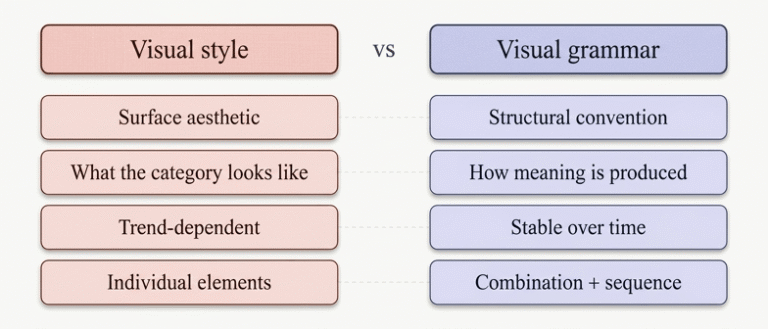
Every category has a visual style — a set of aesthetic tendencies that, at any given moment, most packs in the space share. But visual style is surface. It describes what the category looks like; it doesn’t explain how it produces meaning. That explanation requires going a level deeper, to what semiotics calls visual grammar.
Where visual style groups packs by aesthetic resemblance, visual grammar identifies the stable signifying conventions that underlie those aesthetic choices. A brand can swap out its trend vehicle when it ages — a character, a colour fashion, an illustration style. What it cannot as easily abandon is the underlying convention that vehicle was carrying, because that convention is where the meaning actually lives.
Grammar operates at the level of combination and sequence, which is what visual style analysis typically misses. It isn’t just that individual elements carry meaning — though they do, as established codes within a system rather than decorative choices. It’s that meaning is produced by how those elements combine, and in what order. The syntax of a pack, so to speak, is as significant as its vocabulary.
Once mapped, the grammar becomes a practical tool. Design decisions for a new pack can be tested against it — for coherence, for category fit, for the specific signal a departure will send. This is where the grammar connects to the mechanism behind the semio-savvy pack.
Achieving that top rung of the semiotic ladder — disruptive yet anchored — is only possible when the grammar has been mapped in full. A brand that knows the system can identify exactly where a break is possible, what it will communicate, and how far it can stretch before the category’s meaning is lost.
In the space of Indian Single Malt – Kamet and Indri both anchor their Indian identity to Himalayan geography. But they deploy that anchor completely differently. A comparison of the two reveals how visual grammar determines whether cultural signifiers produce meaningful ideas — or sit as a visual attraction disconnected from the pack’s narrative logic.
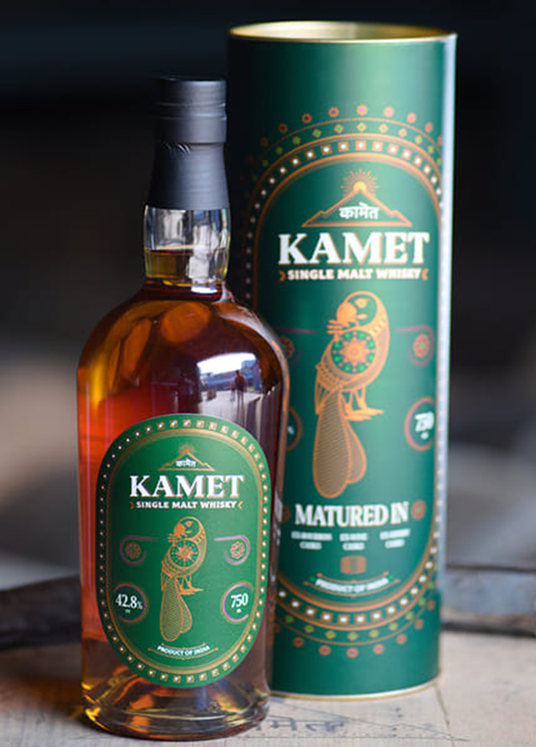
Kamet: Generic Luxury Grammar
In Kamet, the cultural signifiers are forced to speak a language that overrides their intent.
The Elements: A Parrot (references sacred messengers in local village culture) and the name Mt. Kamet (Himalayan purity).
The Disconnection: The mountain reference is trapped in the text of the name; it is never visualized. Meanwhile, the parrot is rendered as ornate decoration rather than a meaningful character.
The Dominant Grammar: The pack uses generic Indian Single Malt grammar—dark jewel tones, heavy gold detailing, and intricate patterning.
The Result: Because the grammar is ‘generic premium Indian’, the consumer reads the parrot as a decorative flourish. The deeper cultural meaning cannot breathe because it has no structural relationship with the rest of the bottle. It is a style applied to a bottle, not a grammar that defines it.

Indri: Grammar of Contemporary Indian Confidence
In Indri, the cultural codes are not ornamentation; they are the ruleset by which the pack is built.
The Elements: Large-scale Devanagari script, the Bindi—singular, precise red circular marker—and the clean, minimalist surface with a ‘matte’ restraint.
The Connection: The elements are not scattered but sit in meaningful interaction with each other. The Devanagari script is the primary anchor that dictates the rest of the bottle’s layout. The Bindi serves as a structural marker, acting as a focal point that forces the eye to recognize the Sanskrit roots of the brand name (“five senses”) before looking at the English text.
The Dominant Grammar: Indri rejects the ‘Generic ISM’ (gold foil and dark tones) in favor of Contemporary Restraint. By borrowing the ‘quietness’ of Japanese design, it strips away decorative noise to frame Indian cultural markers. This minimalist grammar allows the cultural signs to function with structural authority.
The Result: The cultural codes are structural. They aren’t ‘on’ the pack; they are the pack. The consumer doesn’t see ‘an Indian sticker on an international bottle’; they read a new hierarchy where Indian identity is the primary charge, and international luxury codes are secondary and absorbed.
Principle 4: Assessment Is Always Relational
A pack cannot be evaluated in isolation. Whether a design is working — whether it reads as distinctive, credible, or appropriately playful — can only be determined in relation to something else. This sounds obvious, but it has a practical implication that most informal pack evaluations overlook: the reference frame has to be declared upfront, because the choice of comparator shapes the conclusion entirely.
Most design judgements get made without that declaration. A pack is called premium, or dated, or cluttered, with no one specifying what standard is being applied or what the comparison set is. Semiotics insists on making that explicit, because the same pack can tell very different stories depending on where you hold it up.
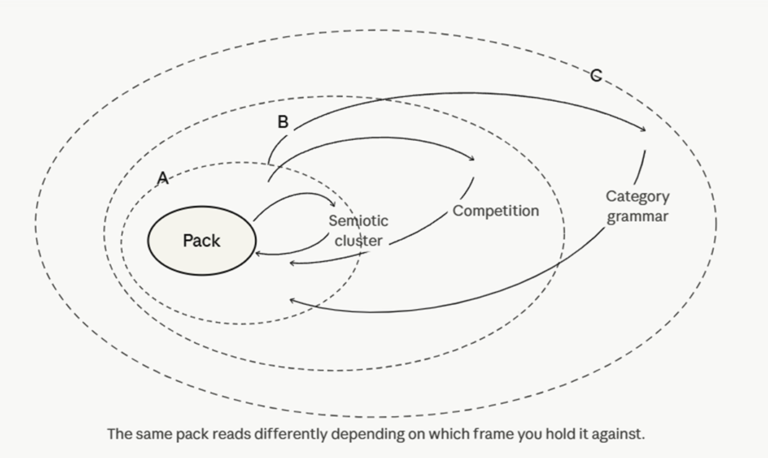
Relational assessment can be structured in three ways, depending on the strategic question. The first is against the category’s established grammar — asking whether the pack is legible and carrying the codes the category demands. The second is against competition, either broadly or within a defined subset. The third, and often most revealing, is within the pack’s own semiotic cluster — a group of packs sharing the same design codes and pointing to a set of shared meanings, an invitation to enter a specific narrative world within the category.
That third mode matters because differentiation is always cluster-relative. A pack that looks distinctive against the broad category may read as entirely generic within its cluster. And a pack that appears to have achieved the semio-savvy position may only appear so when measured against the wrong reference point. Held up against its actual cluster, the disruption may turn out to be a well-worn move.
The choice of reference frame, in other words, is a strategic decision. Getting it right is what determines whether the conclusions a brand draws from its pack assessment are actually usable.
A comparative breakdown of Trikal and Indri shows why.

Trikal: Frames Were Incompletely Audited
Reference frames assessed: Semiotic cluster (other Indian Single Malts) ✓
Direct competition (premium Indian spirits) ✓
Reference frame NOT audited: Broader cultural attitudes (Hindu sacred tradition)
Visual codes: Dark aqua and gold colour scheme (luxury signifiers), male deities and gods in temple sculpture style (divine, meditative mood), circular mark on the forehead (sacred iconography), name meaning ‘eternal’ (elevated quality promise)
What happened: Within the semiotic cluster and competition frames, the codes read as luxury heritage. But when assessed against the third frame—Hindu sacred tradition—the same symbols read as appropriate and offensive. The visual codes became vulnerable to reinterpretation as divinity references applied to a profane product.
Indri: Multiple Frames, All Audited
Reference frames assessed: Semiotic cluster (other Indian Single Malts), direct competition (premium single malts globally)
Visual codes: Devanagari script as primary anchor, the bindi as cultural marker, minimalist Japanese-influenced aesthetic, gold accents signalling international luxury absorbed into Indian identity
What the frames reveal: Against both the ISM cluster and global premium competition, every choice reads coherently. The pack asserts: “I am contemporary, globally accomplished, and culturally confident.”
Assessment: Strategically sound across all audited frames.
The principles outlined above become concrete when applied to specific category spaces. As seen across this piece, the Indian Single Malt Whiskey market offers a particularly revealing case study—one where the tension between belonging and difference plays out across every position on the semiotic ladder.
Visual Case Study: The Semiotic Ladder in Indian Single Malt Whiskey
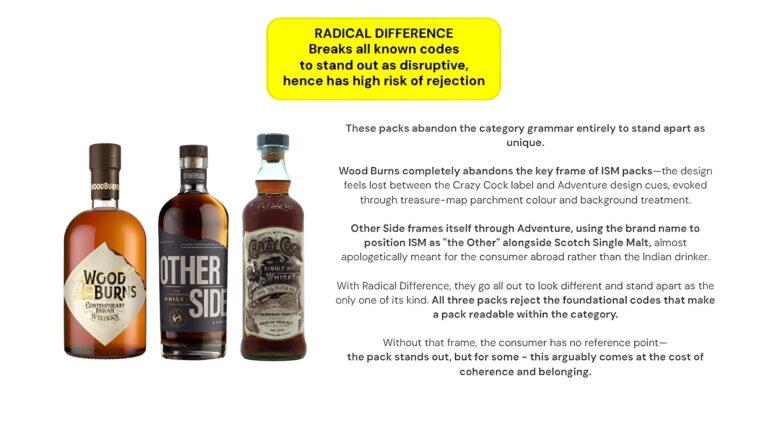
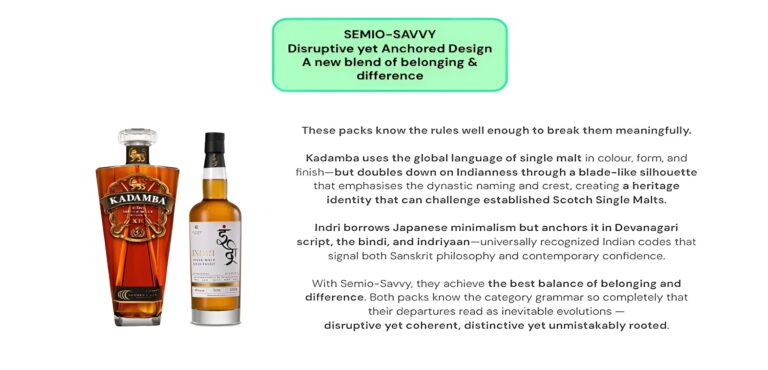
These packs reveal a consistent truth: the brands that achieve both recognition and recall aren’t those that abandon the category’s codes entirely, nor those that follow them blindly. They’re the ones that understand the system deeply enough to move through it with purpose.